Updated February 11, 2026 06:50PM
Once Again, The Internet Got it Wrong About Lindsey Vonn
After her Olympic downhill crash, people came out in droves to spread misinformation. Let's set the record straight.
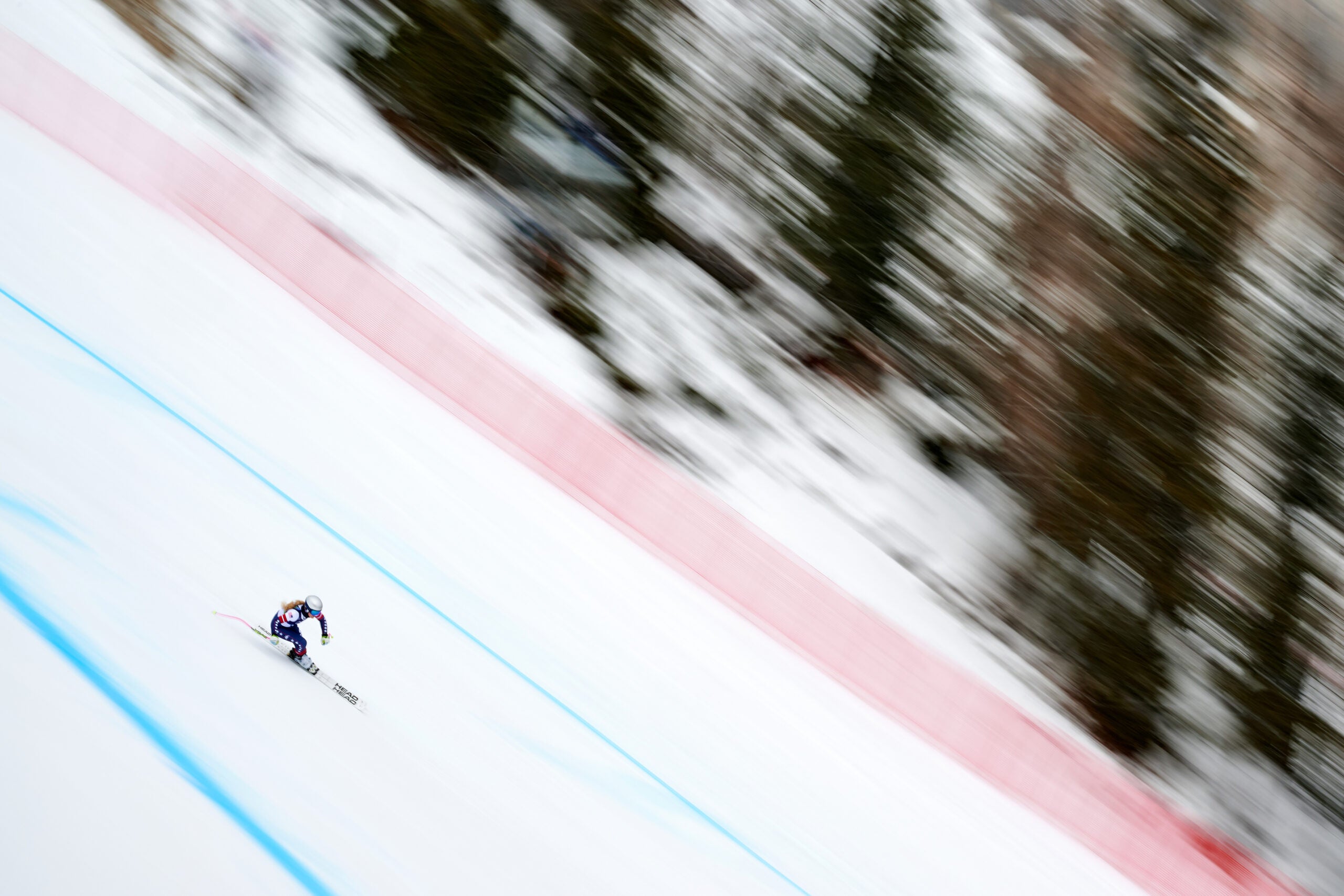
CORTINA D'AMPEZZO, ITALY - FEBRUARY 07: Lindsey Vonn of Team United States of America skis during the Women's Downhill training on day one of the Milano Cortina 2026 Winter Olympics at Tofane Alpine Skiing Centre on February 07, 2026 in Cortina d'Ampezzo, Italy. (Photo by Mattia Ozbot/Getty Images) (Photo: Mattia Ozbot/Getty Images)
By now, everyone from your cousin in South Carolina to your elderly neighbor knows what happened to Lindsey Vonn in the 2026 Olympic downhill—her horrific crash less than 13 seconds into the race and the preamble that led up to it. Ten days before the Olympic downhill, Vonn ruptured the ACL in her left knee in a World Cup downhill at Crans-Montana, Switzerland. Then she chose to race the Olympic downhill. Ski racing is tough enough with fully intact limbs, especially at speeds over 80 miles per hour down a bumpy, jumpy course.
While many people were sympathetic to Vonn, wishing her well and hoping for a speedy recovery, the haters, of course, jumped on the social media bandwagon, voicing their unsolicited (and often uninformed) opinions about everything from Vonn’s decision to race to whether the crash was due to her ACL.
So we are taking time to dispel some of the chatter.
Incorrect take #1: Vonn shouldn’t have raced at all
Ask anyone in the medical profession, and most would surely have recommended that Vonn not race, at least not so soon after her ACL rupture. “The likelihood of more injury is extremely high,” Dr. Kevin Stone told the New York Times before the women’s downhill. Dr. Stone is an orthopedic surgeon at the Stone Clinic in San Francisco and a former U.S. Ski Team physician. “So because of that, doctors, while cheering on her determination, would be extremely cautious about clearing her to do a downhill race.”
ADVERTISEMENT
Why? Because right after a knee injury, anthropogenic muscle inhibition sets in. “It’s an involuntary reduction in muscle activation around the injured knee,” explained Tyler White, athletic trainer at iSport in Killington, Vt., who has helped Premier League soccer players, NHL players, and World Cup skiers rehab from knee injuries. “It’s like turning the dimmer switch down on the muscles.”
But in the lead-up to the race, Vonn appeared superhuman, doing a post-injury workout that would be hard for those of us with intact ligaments. She proved that her body was still strong. And perhaps most important, she has the mind of a champion.
“I’m not giving up 💪🏻 working as hard as I can to make it happen!” Vonn wrote in her workout reel.
As a pro-Vonn commenter replied, “Who do you think is going to ‘stop her’? Her parents? 😂😂😂😂😂 she’s a grown ass woman and made her decision to compete.”
ADVERTISEMENT
Incorrect take #2: Vonn should have ceded her spot to a healthier teammate
Vonn completed two training runs before the Olympic downhill—on a course that she knows better than anyone. She has won 12 times on the Olympia delle Tofane and skied it 65 times.
Six women were named to the U.S. Olympic alpine team for the speed races (downhill and super-G). In the two training runs, Vonn beat all but two of them.
ADVERTISEMENT
In the first training run, she finished 11th—the third-best American that day. The next day, she finished third overall, the second-best American behind Breezy Johnson, who went on to win the Olympic gold medal the next day. And all six U.S. women did the two training runs. There was no indication—or any results-based justification whatsoever—that Vonn wasn’t up for the race.
Incorrect take #3: She crashed due to her ACL
While everyone was quick to blame Vonn’s compromised left knee for her crash—it did, after all, happen after a left-footed turn—it was really her line choice that led to the crash. She came too close to the gate, putting her right arm through it. At downhill speeds, a gate clip can be devastating, twisting a skier’s torso and then their skis, underneath them.
Twisted in mid-air, Vonn’s crash was unavoidable. As the tail of her left ski hit the snow, her tibia couldn’t withstand the forces of physics.
“I was simply 5 inches too tight on my line when my right arm hooked inside of the gate, twisting me and resulting in my crash,” Vonn posted on Instagram from the hospital. “My ACL and past injuries had nothing to do with my crash whatsoever.”
Indeed, it could have happened—and has happened—to athletes on fully intact ACLs.
While Vonn’s Olympic comeback had far from a fairytale ending, she stated that she has no regrets. She had, after all, come farther than she had ever dreamed—with two more World Cup wins this season to bring her total to 84 (third-best behind Mikaela Shiffrin and Ingemar Stenmark).
“Standing in the starting gate yesterday was an incredible feeling that I will never forget,” she wrote on Instagram. “Knowing I stood there having a chance to win was a victory in and of itself. I also knew that racing was a risk. It always was and always will be an incredibly dangerous sport.
“And similar to ski racing, we take risks in life. We dream. We love. We jump. And sometimes we fall. Sometimes our hearts are broken. Sometimes we don’t achieve the dreams we know we could have. But that is also the beauty of life; we can try.
ADVERTISEMENT
“I tried. I dreamt. I jumped.”
The highest levels of athletic competition are filled with big risks. When they pan out, those risks get glossed over. But when they don’t, it’s suddenly all that we see. We simply can’t criticize these athletes for going for it. It’s exactly what they’ve been trained to do, after all.